
Why You’ll Love Antica Masseria Jorche
The map was always there. Hidden in plain sight.
Red earth. Iron-red, blood-red, the color of something ancient and still alive. Vines crouched low to the ground, twisted like the hands of men who had spent a century working the same soil. In Puglia, the locals call this posture alberello — the little tree. A plant that long ago decided it had nothing left to prove.
The treasure is buried inside the fruit.
The Land That the Whole Mediterranean Wanted
Before Rome. Before the Crusaders. There was Manduria.
When you stand in the vineyards here and look out at the red earth, you are seeing exactly what the Greeks saw. This was Magna Graecia, Greater Greece, the civilization that planted its ideas, its philosophy, its politics, and its vines across southern Italy 2,500 years ago. They recognized something in this soil that still holds true today: terra rossa, iron-red earth on limestone, shallow enough to stress a vine into greatness. And the sea. Vines grow near the sand dunes of the Ionian coast, where the wind threads minerality and grace through a grape that, left to pure heat alone, would be too massive to drink with any pleasure. The Greeks understood terroir before the word existed. The culture and taste they shaped here never left.
Two Ancient Grapes. One Story.
The Greeks brought Negroamaro with them, a grape whose name is layered twice over: negro from the Latin for black, amaro possibly from the ancient Greek mavro, also meaning black. Black-black. Named by people who wanted no ambiguity about what was in your cup.
Primitivo arrived later and traveled to get here. A clergyman named Canon Indellicati noticed in the 1700s that one vine in his vineyard matured earlier than all the others. He isolated it, named it Primaticcio, from the Latin Primativus, and the grape spread from the Adriatic toward the Ionian. A Countess from Altamura carried vine shoots to Manduria as a wedding gift, planted in the coastal dunes of Campomari. Horace praised the ancient wines of this territory. Pliny praised them. Lorenzo il Magnifico served them at his symposia of honor.
This wine carries an actual history.
The Masseria. The Family. The Fifth Generation.
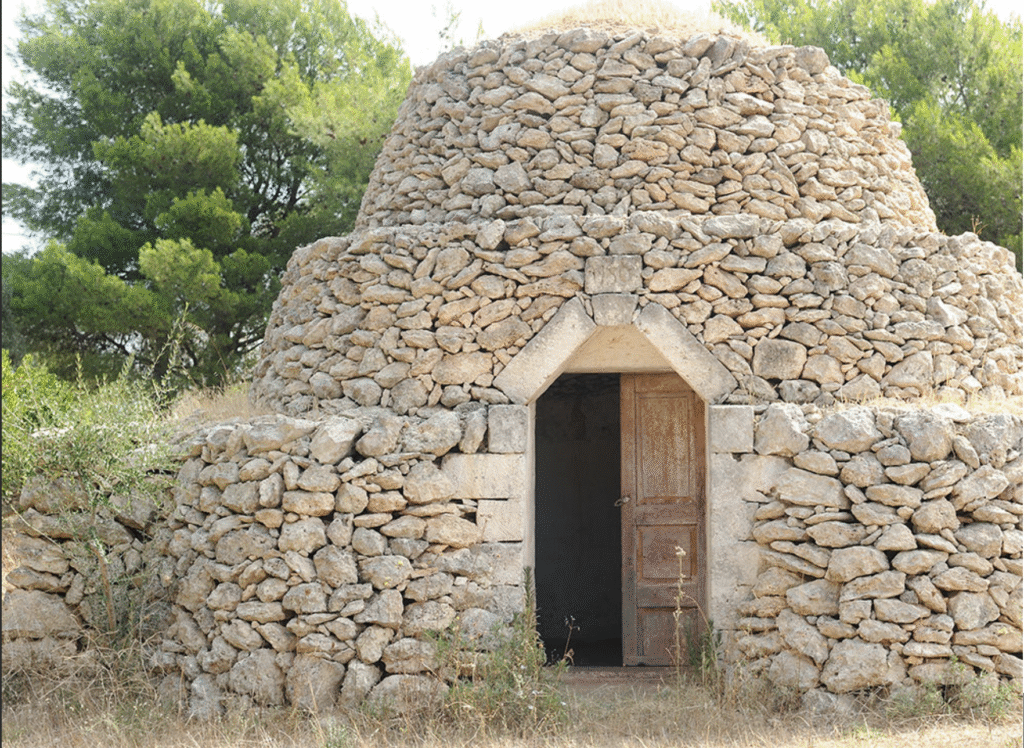
A masseria is the soul of rural southern Italy: a fortified agricultural complex, part farmhouse, part fortress, part community, built to be entirely self-sufficient. Antica Masseria Jorche has stood in Torricella, in the province of Taranto, since the late 17th century under Spanish domination. The name Jorche — transformed in local dialect to Furchi — derives from Spanish and almost certainly belonged to the first owner: a Spanish farmer who claimed this land, built these walls, and left behind a name that outlasted his empire.
The Gianfreda family arrived a century before their 1990 purchase of the Masseria from the heirs of Baron Bardoscia. Five generations worked this land: Giovanni in the original palamientu, the family’s ancient winery. Costantino, who replanted after phylloxera devastated the vines in the 1920s. Cosimo, who built the first mechanical cellar in the 1950s. Antonio, the first to study formally as an enologist.
And now Dalila and Emanuela, sisters, fifth generation, running Jorche together since 2009. Dalila leads marketing and international markets. Emanuela leads the vineyards and the cellar. The winery is entirely run by women, and the wines show it in the best possible sense: precision, restraint, and an intuitive understanding of what the land is trying to say.
The Treasure, Found
The Primitivo wines are deeply fruited — dark plum, black cherry, dried fig — with cool Ionian minerality threading through the warmth. The Negroamaro Rosato Dipinta carries original artwork painted by Emanuela herself on every label. Summer in a glass, with the winemaker’s hand literally on every bottle.
At Gladiator Wine Distribution, we roam the less-traveled road. The red earth is the map. The old vines are the treasure. The Ionian wind is the guardian.
One sip is all it takes to understand it was worth finding.